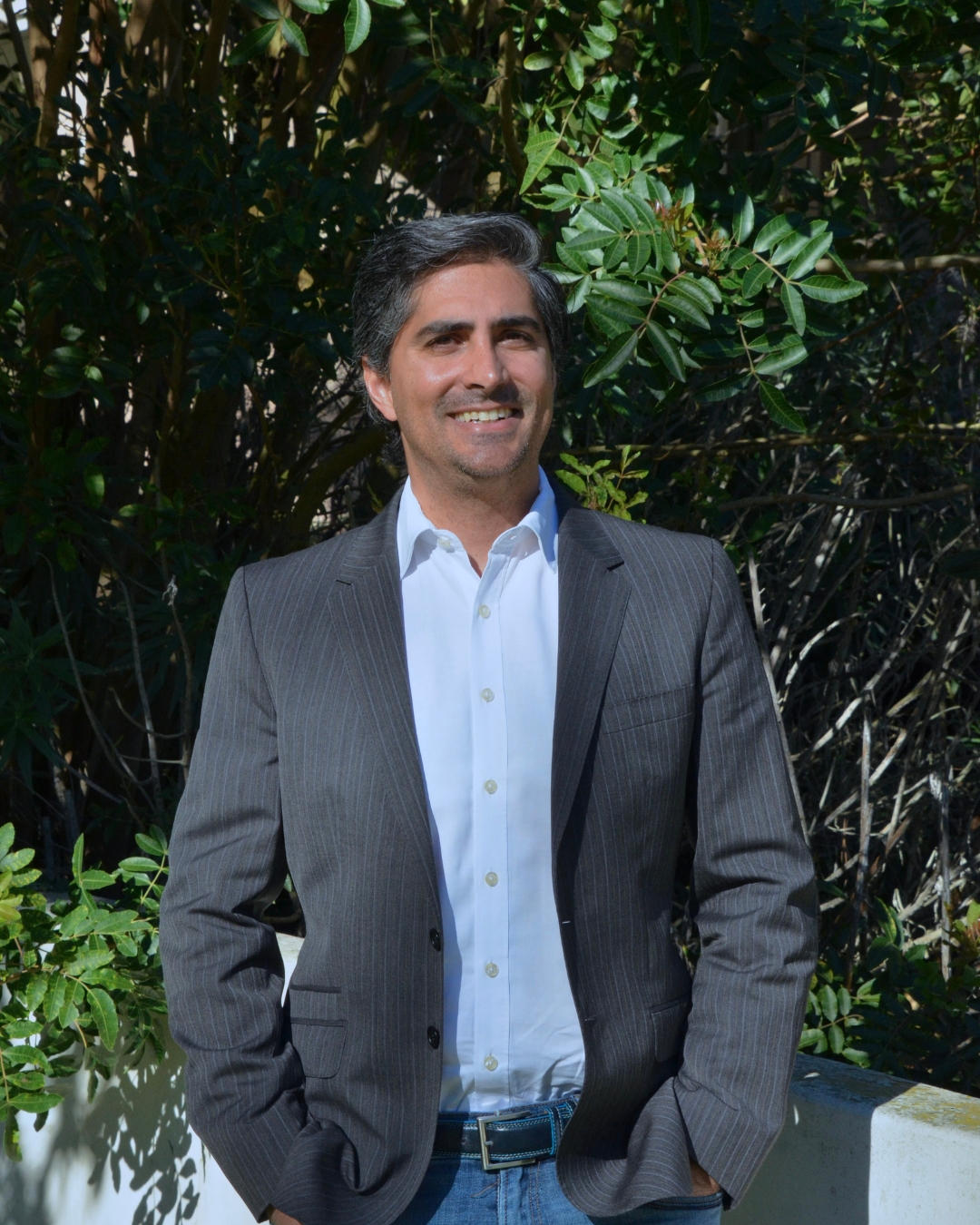
Professor Paasha Mahdavi is a leading political scientist challenging how scholars understand energy politics. Shaped by his upbringing and early exposure to extractive economies, Mahdavi’s work bridges economics, electoral politics, and climate policy. Through global research and local environmental advocacy in Santa Barbara, he examines how industry, power, and governance shape environmental outcomes. Learn more about how his personal journey informs his work toward a cleaner, more equitable future.
Professor Mahdavi is a leading political scientist challenging how scholars and communities understand energy politics. His research examines the interconnections between natural resources, political power, and climate policy. His interest in political power dynamics and energy did not start in a classroom—it began at home. Raised within an Iranian community in San Diego, Mahdavi grew up exposed to the realities of extraction—how resources are extracted, traded, and embedded into global supply chains. By the time he was twelve, Mahdavi was already thinking about cleaner ways to power society, building a small battery-powered car run on solar energy.
Mahdavi began formally studying economics in his undergraduate years, still interested in renewable energy. Over time, however, he realized that economics alone painted only part of the picture. It described how energy markets functioned, but not why outcomes such as pollution, inequality, and political repression persisted in resource-rich countries like Iran. How could a nation with vast oil reserves struggle with autocracy, environmental degradation, and restricted social freedoms, including women’s rights? These questions pushed Mahdavi to think beyond markets and toward power. That shift crystallized after his first year of college, when he took a campaign internship at a San Diego field office and witnessed the political process firsthand. It became clear that energy was inseparable from politics.
That understanding led him into global policy spaces later in his career. Through his work with the World Economic Forum’s Global Future Council, Mahdavi sat at decision tables alongside some of the most powerful energy industry leaders. Watching global climate agreements unfold in the wake of the Paris Accords, he observed how industry leaders embraced solutions like carbon capture not necessarily to reduce fossil fuel dependence, but to sustain it. These experiences reinforced how oil wasn’t just an environmental challenge, but a political one.
Today, as a political scientist, Mahdavi studies the political economy of oil and gas, examining how leaders rely on extractive resource revenues to consolidate and maintain power. His work challenges assumptions that control over oil naturally leads to development, showing how it can also weaken democratic institutions. He studies why governments struggle to implement meaningful and feasible climate policies, as well as what happens to societies as they attempt to phase out fossil fuels. These themes are central to his book, Power Grab: Political Survival Through Extractive Resource Nationalization, which traces how powerful leaders exert authority through control of extractive energy resources. And given recent US actions in Venezuela's oil industry, he has recently lent his expertise through TV interviews with AP News, CBC News, and CBS News and on NPR's All Things Considered.
Mahdavi’s work also highlights overlooked but critical climate challenges—particularly methane. While many environmental political scientists may hesitate to engage directly with the corporate world, Mahdavi’s work aligns commercial incentives and climate responsibility. Through collaborations with the Environmental Defense Fund, Mahdavi helps reframe how national oil companies — because of their emissions footprint and control over methane mitigation — play a pivotal role in determining whether global climate change is achieved.
Through his leadership of the Energy Governance and Political Economy (EGAPE) Lab, he works alongside students and faculty to design climate policies that realistically and effectively mitigate climate change. Mahdavi leads with the belief that meaningful policy in the US can serve as a beacon of possibility for other communities to transition toward a cleaner future.
What sets Mahdavi apart is his ability to bridge worlds: the personal and political, the global and local. His work shows how personal experiences shape our worldviews and, in turn, the solutions we undertake. From building a solar-powered car to shaping climate policy today, Mahdavi has sought to understand how energy shapes power—and how rethinking that relationship can open pathways toward a cleaner, more prosperous future.