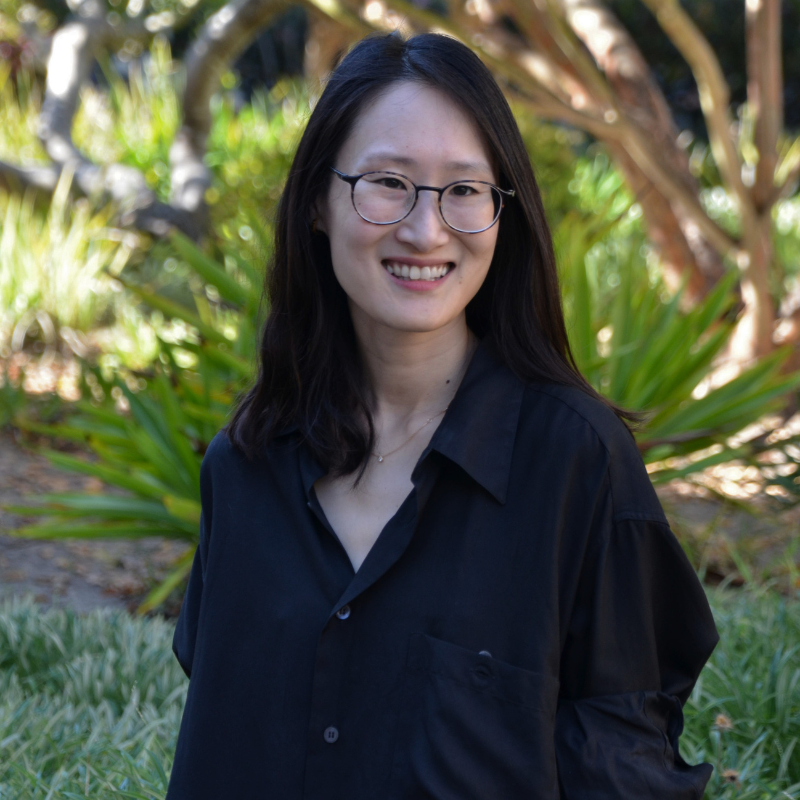
Professor Tae-Yeoun Keum is a political theorist whose work re-examines the role of myth, symbolism, and narrative in political life. Her research bridges classical political thought and contemporary politics. Through her work on Plato and modern political theory, Keum challenges the idea that politics is purely rational, showing how imagination and storytelling continue to shape political identities, movements, and democratic governance.
When Professor Tae-Yeoun Keum arrived at UC Santa Barbara’s Department of Political Science, she brought both an impressive scholarly record, and a deeply personal and global intellectual journey into political theory. Born in Korea and raised in the Philippines, she attended an English-language international school where going abroad for university was common. Moving to the U.S.for college felt less like an abrupt cultural shock and more a part of the “magical,” unfamiliar experience of college itself, with the strangeness of America folded into the excitement of a new environment.
Now an Assistant Professor of political science, Keum’s academic journey began elsewhere. She studied at Yale as a Humanities major – a major that offered expansive intellectual freedom. Within this field, she encountered the “Western canon,” of philosophy where she was able to engage deeply with foundational texts from Plato and Aristotle to Hobbes, Locke, Rousseau, Kant, and Marx. From there, Keum grew curious about how these different political philosophers made sense of the world around them by responding to Plato.
However, her trajectory shifted when a mentor helped her recognize that the kind of work she was already drawn to – close reading, interpretation, and engagement with foundational philosophical texts – was not only legitimate, but central to the field of political theory. What had initially felt like an unstructured academic curiosity began to take shape and direction, opening a pathway toward graduate study and a career in political science.
At the center of Keum’s work is a sustained engagement with Plato. Through repeated study of The Republic and other Platonic texts, she developed a methodological and conceptual foundation that would guide her broader scholarly interests. Plato became not only a subject of study, but also a lens through which she approached other thinkers, allowing her to navigate complex philosophical traditions with greater clarity.
Her first book, “Plato and the Mythic Tradition in Political Thought,” examines the role of myth in political thought, particularly in Plato’s work and its modern legacy. Rather than treating myth as a relic of pre-rational societies, Keum repositions it as an enduring and dynamic force within political life. Her research highlights how myths and symbolic narratives continue to shape political identities, collective action, and the ways communities understand power and belonging.
Importantly, her work does not romanticize myth. Instead, it carefully traces its dual capacity: myth can both reinforce exclusionary ideologies and provide tools for solidarity and resistance. Contemporary political movements, particularly those grounded in cultural or historical identity, often draw on symbolic narratives to articulate goals and define their place within broader political struggles. Keum’s work brings these dynamics into focus, showing how imagination, narrative, and symbolism remain central to political life.
Keum remains committed to making political theory both rigorous and accessible. Her teaching emphasizes the relevance of classical ideas in understanding contemporary political challenges, encouraging students to see theory not as distant or abstract, but as a living framework for interpreting the world around them. She creates spaces for students to grapple with theoretical ideas while connecting them to present-day concerns.
At a moment when political discourse is increasingly shaped by competing narratives, symbols, and interpretations of truth, Keum’s work underscores the continued importance of political theory. Her work reveals that the questions at the heart of the field – especially those about power, meaning, and collective life – are not confined to the past. They remain essential to understanding the present and imagining possible futures.