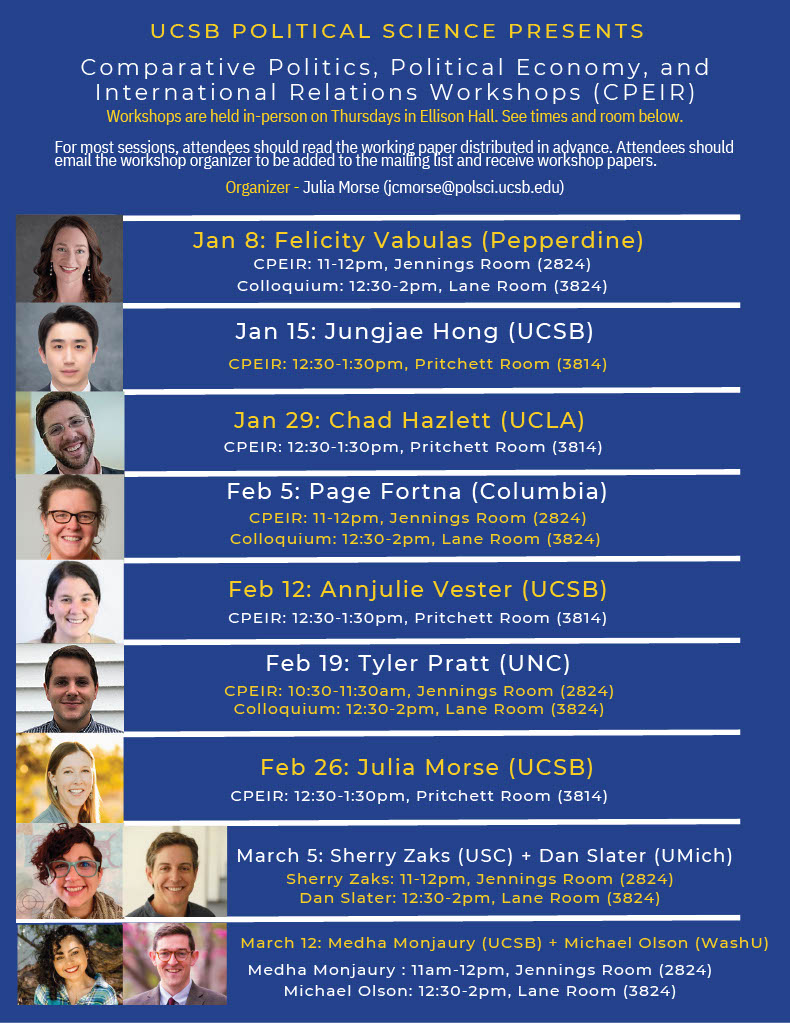
When: Thursday, March 5th
Where: Ellison Hall, 2824
Time: 11:00 - 12:00pm
Title of Talk: #NotAllMarxists: Exploring the power and limits of organizational ideology in rebel groups
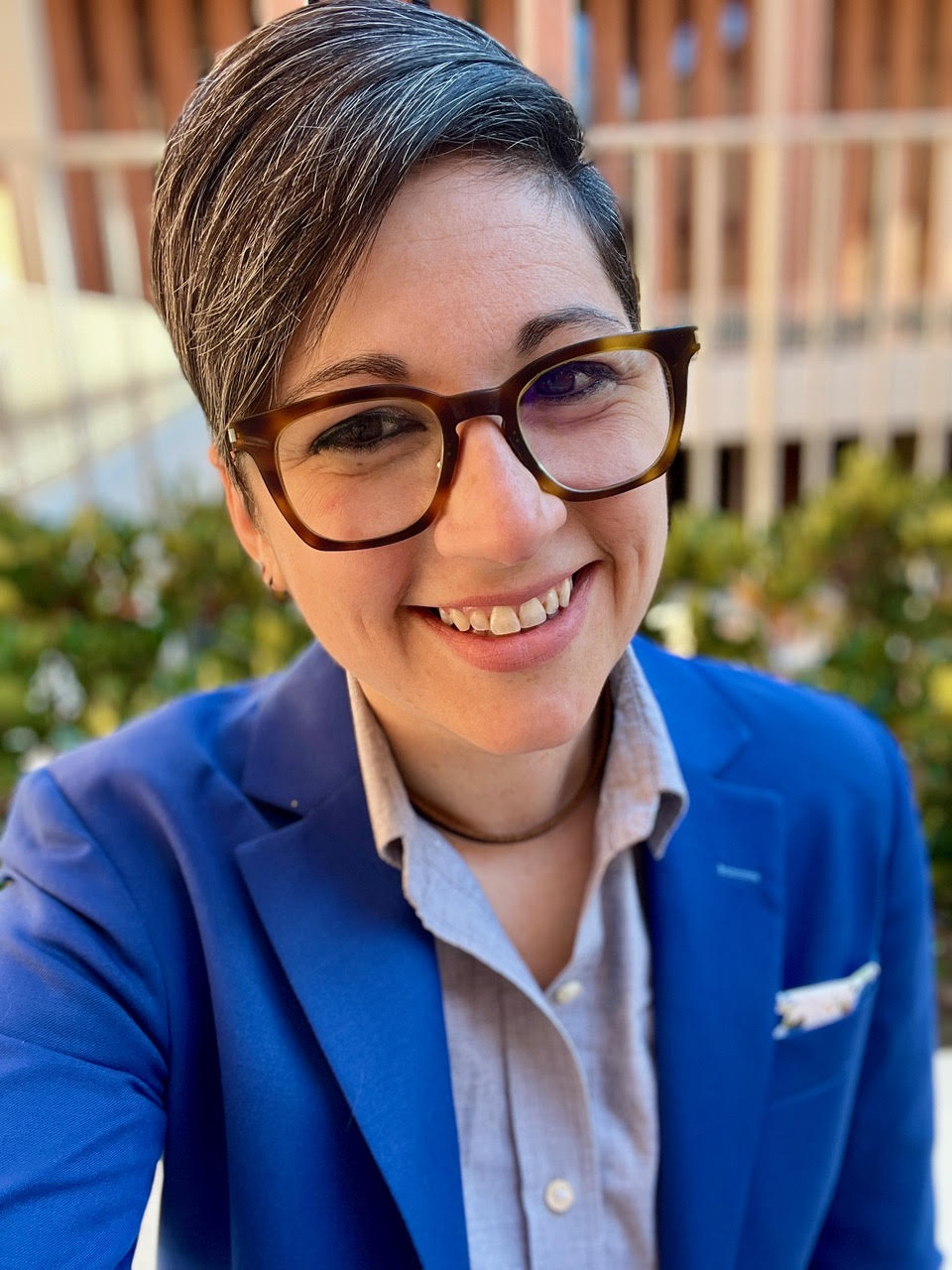
Bio: Sherry Zaks is an assistant professor of Comparative Politics and Political Methodology at the University of Southern California where they teach courses on conflict and political violence, terrorism and genocide, research design, and statistics. Zaks's first book, Resilience beyond Rebellion: How Today's Rebels become Tomorrow's Parties was published by Cornell University Press in 2025. They are currently working on a new book about the process by which armed groups adopt and adapt ideological doctrine. Their previous work has appeared in EJIR, Political Analysis, Journal of Peace Research, and Comparative Politics.
Abstract: With varying levels of success, conflict scholars have leveraged rebel group ideology to explain repertoires of violence and restraint, recruitment profiles, cohesion, conflict duration, and rebel-to-party transition. Yet, for every clear case where ideology seemed to explain the outcome, we can find just as many clear exceptions. Empirical evidence from the ground reveals a consequential disconnect between the ideological doctrine to which groups subscribe and its implementation in practice. Though scholars acknowledge divergences, they are most-often treated as idiosyncratic adaptations or diminished subtypes of doctrine. This manuscript aims to systematize these adaptations by proposing the concept of organizational ideology. Organizational ideology captures the logically-consistent (though not static) framework of value-driven principles, priorities, and goals that emerges when the broad tenets of doctrine are filtered through an organizational body in a specific context. The manuscript presents a conceptual definition of organizational ideology, a set of measurable dimensions along which it varies, and an empirical analysis demonstrating both its conceptual validity and predictive value. Using comparative process tracing, I elaborate the organizational ideology of the FMLN's subgroups during the Salvadoran Civil War. I demonstrate that these ideologies---more than resources, social networks, or structural factors---predict the organizations they build during wartime.
Workshops are held in-person on Thursdays in Ellison Hall. See times and rooms for each upcoming session on the attached flyer. For most sessions, attendees should read the working paper distributed in advance. Attendees should email the workshop organizer (jcmorse@polsci.ucsb.edu) to be added to the mailing list and receive workshop papers.